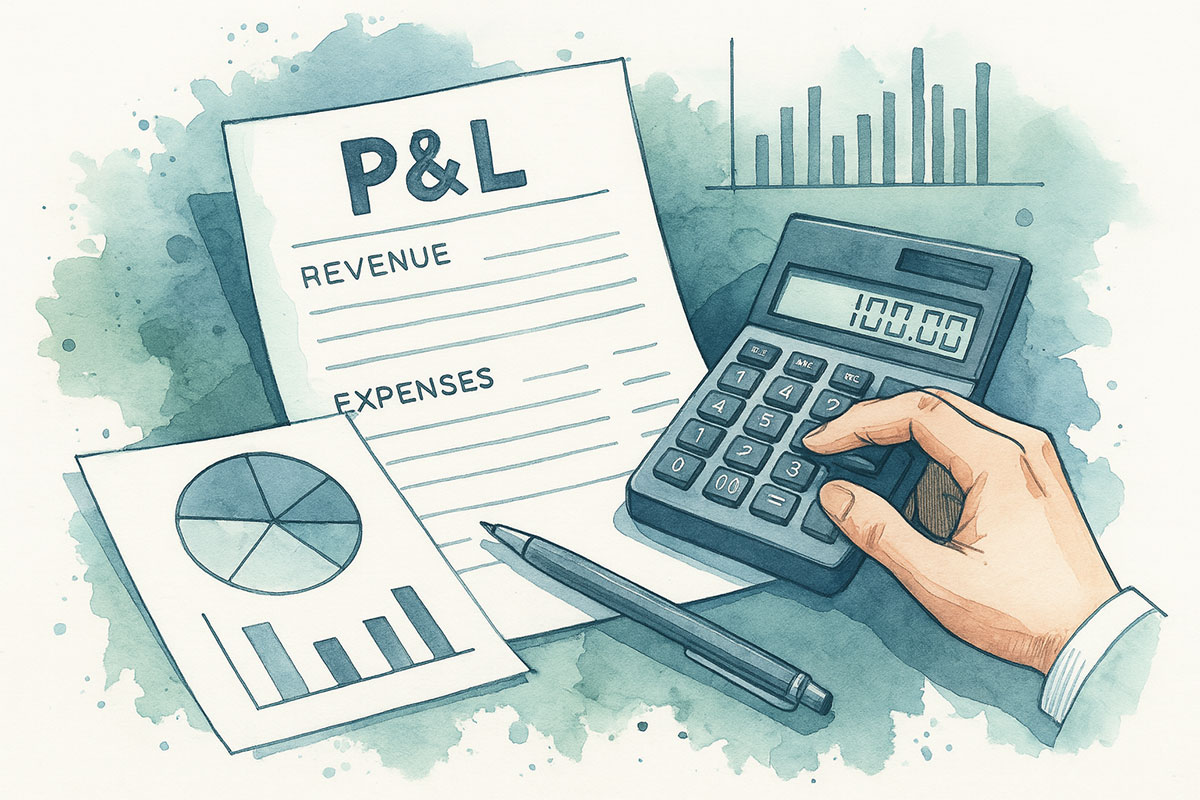
A P&L, or Profit and Loss Statement, is a financial report used to summarize a company’s revenues, costs, and expenses during a specific period.
Also known as an income statement or statement of operations, the P&L breaks down how much money a company earned (revenues), how much it spent (expenses), and whether it made a net profit or a net loss. This information is typically presented on a monthly, quarterly, or annual basis.
A well-prepared P&L provides valuable insight into a business’s operational performance. It helps business owners understand which activities are generating income and which are draining resources. For stakeholders—including investors, lenders, and management—a P&L offers a quick snapshot of financial health and efficiency.
The structure of a P&L typically begins with gross revenue, subtracts cost of goods sold (COGS) to calculate gross profit, and then lists various operating expenses such as salaries, rent, utilities, and marketing costs. The final section includes non-operating items, such as interest and taxes, to arrive at net income.
Similar Accounting Terms
Income Statement – A synonymous term for the P&L. Both refer to the same financial report showing profits and losses during a reporting period.
Statement of Operations – Another interchangeable name for the P&L, commonly used in government agencies, non-profits, and healthcare institutions.
Balance Sheet – A different financial report that shows a company’s financial position at a single point in time. Unlike the P&L, it includes assets, liabilities, and equity but does not show profitability over time.
Cash Flow Statement – Shows the actual movement of cash in and out of a business. While the P&L includes accrual-based items (like unpaid invoices), the cash flow statement tracks real-time liquidity.
Operating Statement – A less common term used internally by some companies for their P&L, especially when focused on business segments or departments.
Operating Margin – A profitability ratio derived from the P&L. It shows how much of each dollar in revenue remains after paying operating expenses.
EBITDA – Stands for Earnings Before Interest, Taxes, Depreciation, and Amortization. Often calculated using P&L figures to assess operational profitability without the impact of financing and non-cash expenses.
Common Misconceptions
“The P&L shows how much cash the business has.”
This is a frequent misunderstanding. A P&L reflects accounting entries, not actual cash. For example, a business may report a profit while facing cash shortages due to unpaid receivables or large loan repayments. Real-time cash positions are shown on the cash flow statement, not the P&L.
“A positive net income guarantees financial health.”
While a profitable P&L is a good sign, it doesn’t necessarily mean the business is financially secure. A company could be profitable on paper but heavily indebted or low on cash. Comprehensive financial evaluation requires looking at all financial statements, including the balance sheet and cash flow statement.
“Only large corporations use P&Ls.”
P&Ls are not exclusive to large businesses. Small businesses, freelancers, and even nonprofit organizations prepare income statements regularly to manage finances and comply with regulations.
“P&Ls are only useful during tax season.”
The P&L is valuable year-round. It serves as a regular tool for performance tracking, budgeting, forecasting, and strategic planning. Waiting until tax season to review a P&L often leads to missed opportunities or overlooked issues.
“All expenses are bad for a P&L.”
Expenses are necessary for generating income. The goal is not to eliminate spending entirely but to ensure that each expense contributes to revenue generation or supports critical operations. A healthy P&L balances investment in growth with cost control.
“Revenue equals profit.”
Revenue is the total income before any deductions. Profit—or net income—is what remains after subtracting all operating and non-operating expenses. Confusing the two can lead to overestimating the company’s financial strength.
Use Cases
Small Business Owners – Use the P&L to review earnings trends, cut unnecessary costs, and make day-to-day decisions with real data. A monthly review of the P&L helps prevent financial surprises and supports sustainable growth.
Startup Founders – Early-stage companies rely on the P&L to monitor burn rate, track customer acquisition costs, and project when the business might become profitable. It also helps prepare for fundraising rounds.
Investors and Shareholders – Analyze P&L statements to evaluate profitability and cost management. Year-over-year comparisons of P&Ls offer insight into whether a company is growing or losing ground.
Loan Applications – Banks, credit unions, and private lenders request up-to-date P&Ls to assess whether a business can manage additional debt. Lenders may use these reports to determine creditworthiness or risk level.
Tax Preparation – A P&L simplifies tax filing by organizing income and deductible expenses. For sole proprietors and small businesses, it’s essential for preparing Schedule C or business tax returns.
Strategic Planning and Forecasting – Management teams use P&Ls to guide operational plans and budget allocations. Profit and expense trends influence hiring, inventory purchasing, product development, and marketing strategy.
Internal Performance Reviews – Department heads or team leaders may use departmental P&Ls to evaluate internal performance. This allows for tighter budget control and more informed resource distribution.
Auditing and Compliance – Auditors require P&Ls during financial audits to verify reported earnings. Nonprofits must submit income statements for compliance with grant funding requirements or IRS Form 990.
Franchise Reporting – Franchisees submit periodic P&Ls to parent companies to monitor location-level performance. Franchisors may use aggregated P&Ls to compare performance across regions.
Board of Directors – Boards rely on P&Ls to set policy, authorize budgets, and review executive performance. The income statement often serves as a foundational document in board meetings and investor calls.